BMI Calculator (Body Mass Index)
Estimate your Body Mass Index (BMI) using standard World Health Organization (WHO) formulas. Calculate healthy weight ranges, category classifications, and personalized body composition insights.

Understanding Body Mass Index (BMI)
Body Mass Index (BMI) is an internationally recognized anthropometric metric developed by Belgian mathematician Adolphe Quetelet in the 19th century. It quantifies an individual's tissue mass (muscle, fat, and bone) relative to their stature, categorizing them into standardized weight classifications defined by the World Health Organization (WHO) and the Centers for Disease Control and Prevention (CDC).
While BMI does not measure body fat directly, extensive epidemiological studies confirm that it correlates strongly with direct laboratory measurements of body fatness, including dual-energy X-ray absorptiometry (DEXA), underwater hydrostatic weighing, and air displacement plethysmography.
The Mathematical Formula
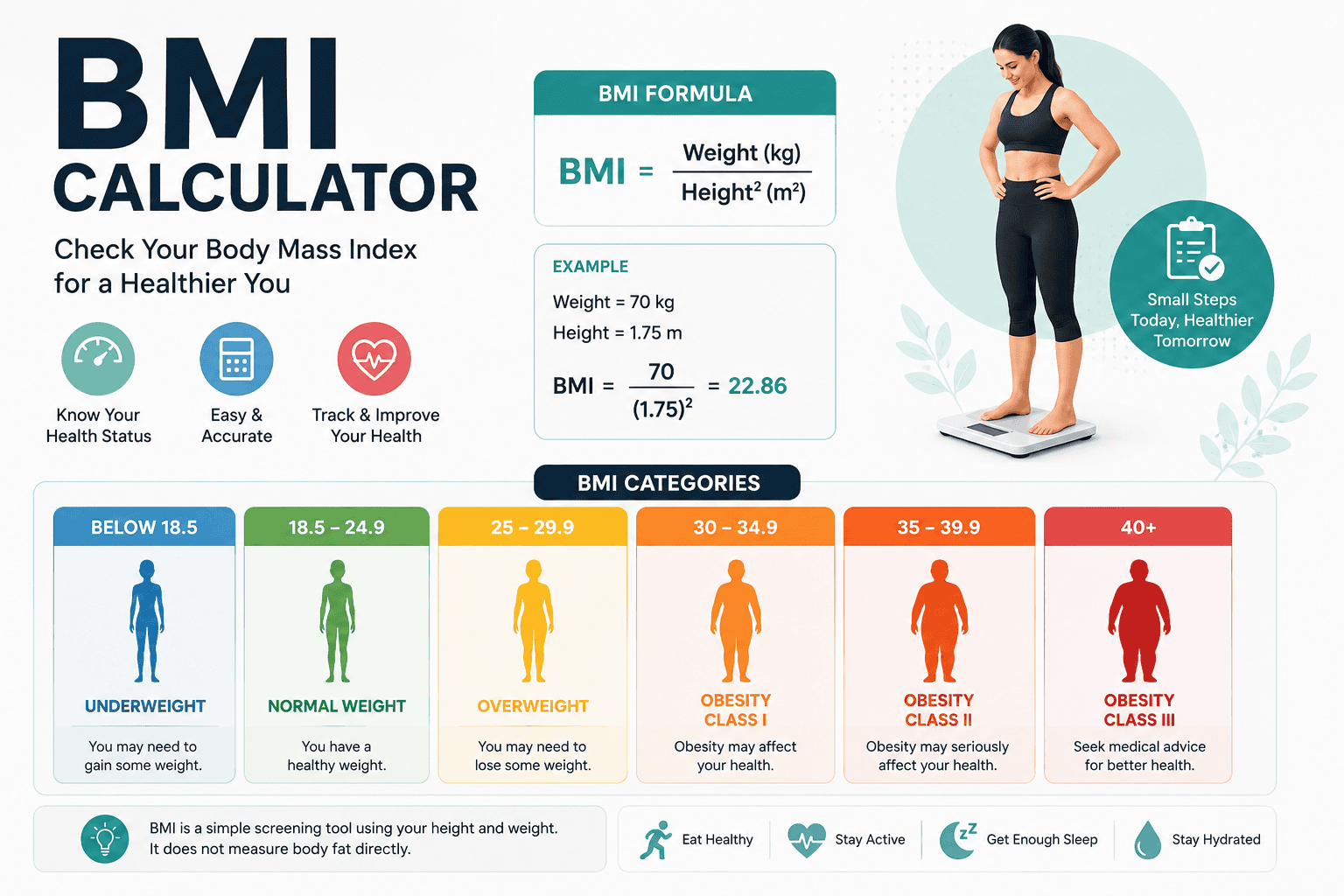
BMI is computed by dividing an individual's body weight in kilograms by the square of their height in meters. For individuals using United States customary or Imperial measurements, an adjustment scaling factor of 703 is utilized.
Step-by-Step Calculation Example
Consider an individual who weighs 72 kilograms and stands 1.76 meters (176 centimeters) tall:
- Square the height in meters: 1.76 × 1.76 = 3.0976 m².
- Divide weight by squared height: 72 ÷ 3.0976 = 23.24 kg/m².
- Result interpretation: A BMI score of 23.2 falls squarely within the Normal Weight clinical interval (18.5 to 24.9).
Standard WHO Adult BMI Classifications
| Classification | BMI Interval (kg/m²) | Health Risk Profile |
|---|---|---|
| Underweight (Severe) | < 16.0 | Elevated risk of nutrient deficiencies, osteoporosis, and impaired immunity |
| Underweight (Mild to Moderate) | 16.0 – 18.4 | Increased vulnerability to fatigue, hormonal disruption, and electrolyte imbalance |
| Normal Healthy Weight | 18.5 – 24.9 | Lowest statistical risk for cardiovascular disease, metabolic syndrome, and mortality |
| Overweight (Pre-obese) | 25.0 – 29.9 | Moderate risk for arterial hypertension, elevated LDL cholesterol, and type 2 diabetes |
| Obesity Class I | 30.0 – 34.9 | High risk for atherogenic dyslipidemia, coronary heart disease, and osteoarthritis |
| Obesity Class II | 35.0 – 39.9 | Very high clinical risk of obstructive sleep apnea, stroke, and cardiovascular mortality |
| Obesity Class III (Severe) | ≥ 40.0 | Extremely high health risk requiring clinical intervention and medical supervision |
Important Limitations of BMI
Although BMI is an invaluable, accessible public health screening metric, it possesses notable clinical limitations that should be accounted for when evaluating individual wellness:
- Muscularity & Athleticism: Dense skeletal muscle tissue weighs significantly more per unit volume than adipose tissue. Bodybuilders and strength athletes frequently register BMIs above 28 or 30 despite possessing single-digit body fat percentages. For muscular individuals, calculate with our Body Fat Calculator for superior precision.
- Age-Related Sarcopenia: Older adults naturally lose lean muscle tissue and gain visceral adipose tissue without experiencing substantial changes in gross scale weight, occasionally underestimating health risks in senior populations.
- Ethnic Variations: Clinical research by the WHO demonstrates that individuals of South Asian and East Asian ancestry possess a higher percentage of body fat and visceral adiposity at lower BMI thresholds. Many international guidelines recommend an overweight threshold of 23.0 kg/m² and an obesity cutoff of 27.5 kg/m² for Asian populations.
- Pregnancy & Lactation: Standard BMI calculations do not apply to pregnant or postpartum mothers. Please reference our Pregnancy Due Date Calculator for prenatal tracking.
Practical Strategies for Achieving a Healthy Weight
If your BMI falls outside the normal interval, evidence-based lifestyle modifications offer steady, sustainable progress:
- Calculate Your Basal Energy Needs: Use our BMR Calculator and TDEE Calculator to identify precisely how many calories your body burns every 24 hours.
- Structured Energy Balance: Establish a mild, healthy calorie deficit of 300 to 500 calories for fat loss, or a moderate surplus for lean muscle hypertrophy using our Calorie Calculator.
- Prioritize Dietary Protein & Fiber: Consume 1.6 to 2.2 grams of protein per kilogram of body weight alongside whole foods to maintain metabolic rate and promote satiety.
- Stay Adequately Hydrated: Fluid balance optimizes cellular metabolism and appetite control. Check your requirement with our Water Intake Calculator.
- Incorporate Progressive Resistance Training: Building skeletal muscle enhances insulin sensitivity, bone mineral density, and resting metabolic rate.
Frequently Asked Questions About BMI
Related Health & Biometric Tools
Expand your wellness tracking with our evidence-based calculator suite: